


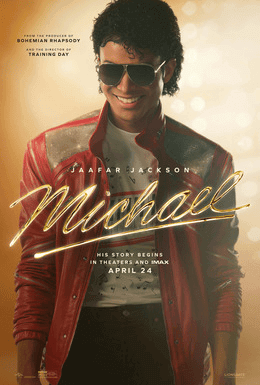
I went to the cinema to see Michael yesterday.
And before you say anything, yes, I know. Biopics are creative interpretations. They take liberties. They’re not documentaries. So just to be clear from the outset, I’m not here to pass judgment on a real person’s life. I’m here to talk about what the story made me feel, and more specifically, the thoughts I haven’t been able to switch off since I walked out of that cinema.
Fair warning. If you haven’t seen it yet, I’m keeping this spoiler-free. But you probably already know the broad strokes.
Here’s the question I keep turning over.
Would he have been as great if he’d had a different father?
And I don’t mean “would he have been successful.” I mean... would he have been that extraordinary? Is exceptional trauma somehow the engine that drives exceptional artistry? Or was that level of greatness always baked in, and the abuse just made the whole thing messier and more tragic than it needed to be?
I genuinely don’t know. But I can’t stop thinking about it.
The other thing I couldn’t stop noticing was how his neurodivergence was woven through the story. Not labelled. Not announced. Just... there, if you know what you’re looking for. The way he moved through life. The way he couldn’t be still. The way the environment felt wrong for him in a way that probably couldn’t have been articulated at the time.
I recognised it.
And then there was the animals thing. I learnt recently from my psychologist that people on the spectrum often have a stronger connection to animals than to people. It’s not a quirk. It’s a pattern. So when I saw that play out on screen, I wasn’t surprised. I just thought, of course.
Here’s what I keep coming back to, though.
What happens when neurodivergent people get to fully inhabit their gifts rather than spend their energy performing something they’re not?
Because that’s the other edge of this. So much of what we ask of neurodivergent kids, and honestly, neurodivergent adults, is conformity. Sit still. Follow the structure. Do it the ‘normal’ way. And I think there’s a version of that story where the extraordinary gets quietly sanded down in the name of fitting in.
The movie also made me think about what we’ve lost creatively as a culture. The big, weird, boundary-pushing artists. The ones who didn’t seem to care whether their work was palatable or mainstream-friendly. Where have they gone? I have a theory that it’s partly because we’ve built systems (social media, algorithms, cancel culture, call it what you want) that punish the edges. And the edges are often where the neurodivergent brain lives.
Maybe that’s the real cost of forcing conformity. Not just on the individual, but on all of us.
Anyway. A lot of thoughts for a Sunday afternoon at the movies.
Have you seen it? I’d love to know what it stirred up for you, whether you’re neurodivergent yourself or just a person who finds themselves thinking about these things late at night when you should really be asleep.
Which, honestly, same.